
Fantasy Life , Level-5 and Brownie Brown's life sim and action RPG, is a game with a long and storied history. Originally announced in Japan for the Nintendo DS/DSi generation of consoles back in 2009, it spent three years in development, seeing a platform upgrade to the Nintendo 3DS, finally releasing in Japan-only on 27th December, 2012.
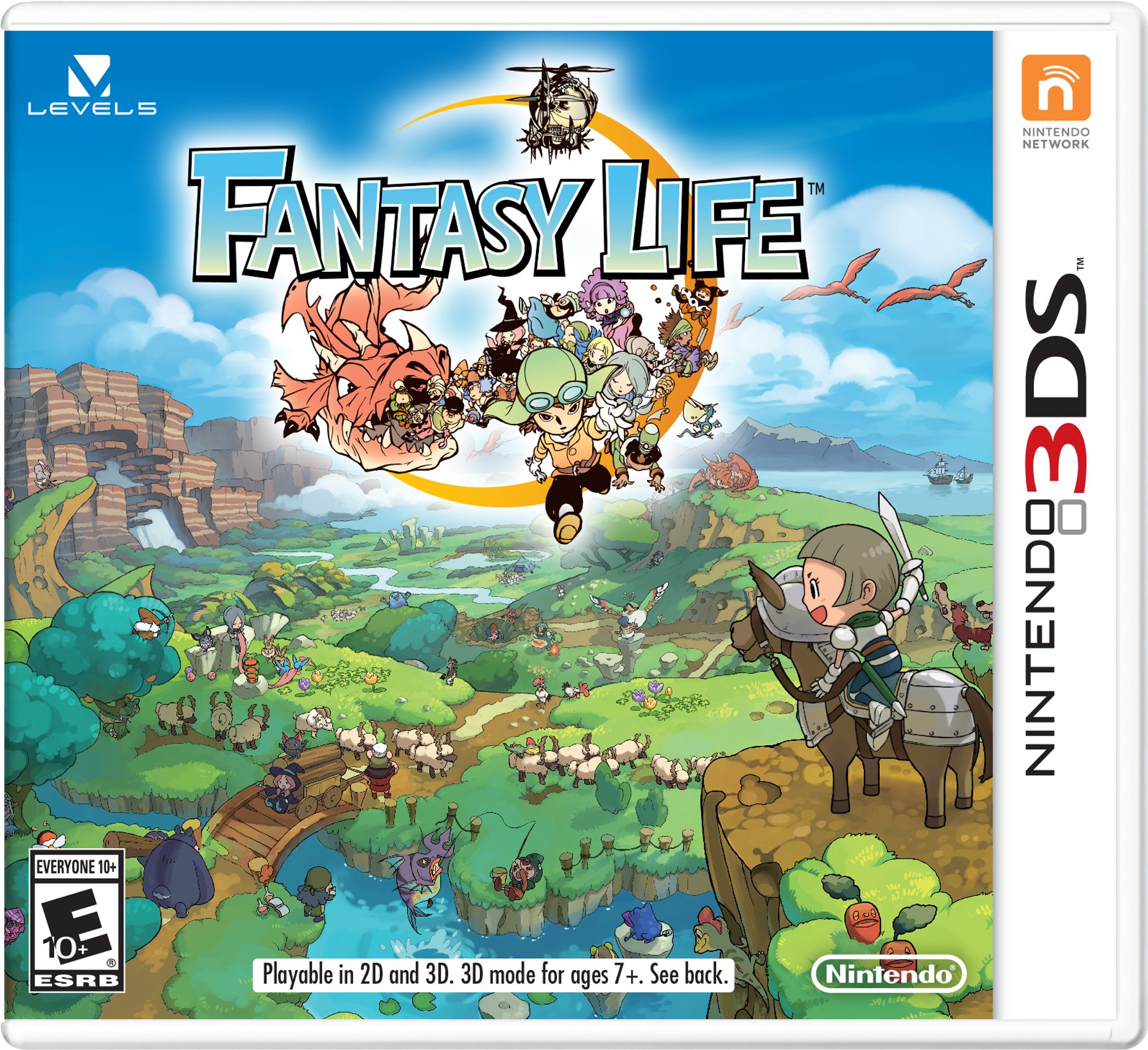
, Level-5 and Brownie Brown's life sim and action RPG, is a game with a long and storied history. Originally announced in Japan for the Nintendo DS/DSi generation of consoles back in 2009, it spent three years in development, seeing a platform upgrade to the Nintendo 3DS, finally releasing in Japan-only on 27th December, 2012.
Fantasy Life was closely watched by the western gaming press as the companies and staff involved in its production reads like a who's who of Japanese games industry RPG notables. In addition to Level-5, legendary character artist Yoshitaka Amano and early Final Fantasy composer Nobuo Uematsu are also credited on Fantasy Life. Most notably, Fantasy Life is the final game developed by Brownie Brown — before a restructuring and name change to 1-UP Studios — a company that holds a special place in JRPG fans' hearts for, among other things, its involvement with Mother 3, a game that was never officially released in the West. Now that Fantasy Life is finally arriving on western shores, does it deliver on the promise of its formidable creative staff? Absolutely.
At first blush the action RPG elements of Fantasy Life seem almost par for the course — the medieval fantasy setting, a dragon threatening the land, a race of cuddly creatures called the Plushies who haven't yet grasped that their name doesn't form the basis of the Queen's English; but the game excels by expanding the scope of the adventurer's journey by integrating it with the game's life sim features. In addition to gaining XP and earning Dosh (the in-game currency) for littering the landscape with creature corpses, each Life has its own series of challenges which award stars.
When enough stars are earned, the player ranks up in the Life they are currently living and gains access to new skills or recipes that also mostly remain usable when a character switches Lives, with one exception. Special Skills, unusually powerful or useful techniques, can only be used as part of the character's current Life. While the game certainly supports focusing exclusively on picking up a sword and going to town on the local wildlife or just hanging around the city selling handmade furniture, the full experience of Fantasy Life lies in developing a well-rounded character that can craft his or her own armour and weapons, potions, stat-boosting foods, and more.
All of this may sound like you're building a personal mobile weapons platform that can knit its own ammunition during recoil phases, but the game's difficulty is handled surprisingly well. You won't find yourself switching Lives and single-shot killing everything in sight, and the monsters of new kingdoms feel appropriately challenging once the areas become available. Combat is centred around using special button presses to execute certain moves, requiring a bit of timing to master but certainly not especially difficult, even to action RPG newcomers.
Fantasy Life isn't a game of statistics, gear dependence, and power grubbing, and this is evident in its somewhat eccentric user interface. While the screens are beautifully laid out and clean, this forces some useful information off of the top-level screens. It takes a few button presses to check out an item's statistics, and while shopping there's no immediately visible comparison between currently equipped gear and the selected item in the shop, again taking a few button presses to access. Fantasy Life is obviously not a title for people in a hurry.
Several of Fantasy Life's Lives involve producing goods, such as armour, clothing, and furniture by means of a short minigame. The crafting process is straightforward, requiring changing your character's position at the workbench and then performing the related task at that station in time with the indicator using the A button, and activating special skills once available. The difficulty is noticeable but not punishingly so — it's possible to miss a few taps or launch your character to the wrong place at the workbench and still make the item in the allotted time. Should you fail, your crafting materials will not be consumed, leaving you free to try again with no penalty; another example of design generous to less experienced players.
In addition to XP for character level gains and and stars for Life ranks, there's a third system, called Bliss, that awards points for other life sim related tasks like exploration, making in-game allies and decorating or buying new homes. As you increase your Bliss, you are awarded things like bigger bags, the ability to utilize mounts from different kingdoms and enhanced shopping experiences. Bliss is administered by Flutter, a talking butterfly that becomes your constant companion and neck piece early on in the game.
Fantasy Life's art is superb, with a beautifully colourful palette and cartoony, stylised graphics that are just unrealistic enough to avoid looking ridiculous; the 3D effect works consistently and adds even more richness to the already pleasing graphics. Unfortunately, it does suffer from some minor visual issues. The perspective, which is midway between a top-down and a side view — combined with the relatively low resolution of the 3DS — means that details get somewhat crunched to fit the available pixels or lost entirely, an issue which mostly affects in-game characters — the environment art is consistently fantastic. There was some obvious slowdown in the main cities at times, but this didn't occur frequently enough to be a major concern while playing. If you're looking for pure graphical heft Fantasy Life won't satisfy, but the art definitely supports and enhances the game world's presentation.
Brownie Brown has created a game world suitable for all ages, but mature enough in its presentation that it won't turn off the legal-to-drive crowd. The game's main story addresses themes of acceptance and cooperation in a way that any pro-social parent would be proud to hector their children with. The in-game cinematics that advance the main story, of which there are sadly few, are every bit as delightful as what we've already seen in the game's many trailers, and the 3D effect makes them feel that much more vivid. The music also supports Fantasy Life's light-hearted and humorous tone, but it's not all kazoos and glockenspiels — the bell and violin theme that plays in Castele's city at night is simply and gorgeously haunting.
It should also be noted, though its level of attraction will vary, that this isn't an exclusively single-player adventure. Fantasy Life's multiplayer allows players to get together locally or online in groups of up to three and accomplish the same tasks and challenges as in single-player mode (although it is not possible to advance the main story in multiplayer). With the variety of Lives to live and the range of tasks to perform, any trip to any kingdom with just about anyone is sure to be productive in some way — and you might just get the right help to finally defeat that challenge monster that's spent far too long in your Life list.
Link mode also allows you to send your online friends messages (both group-wide and private), notifications and applause without actually playing together. The onscreen keyboard is alphabetical and not QWERTY, so expect a learning curve when trying to stylus- or fingernail-tap out a message. Using StreetPass, tagged players' Fantasy Life avatars can appear as residents in your main town of Castele; speak with them enough to become friends and eventually they may reward you with gifts. These are welcome touches that will add a great deal to the experience for some, or at the very least offer a fun diversion.

At first blush the action RPG elements of Fantasy Life seem almost par for the course — the medieval fantasy setting, a dragon threatening the land, a race of cuddly creatures called the Plushies who haven't yet grasped that their name doesn't form the basis of the Queen's English; but the game excels by expanding the scope of the adventurer's journey by integrating it with the game's life sim features. In addition to gaining XP and earning Dosh (the in-game currency) for littering the landscape with creature corpses, each Life has its own series of challenges which award stars.
When enough stars are earned, the player ranks up in the Life they are currently living and gains access to new skills or recipes that also mostly remain usable when a character switches Lives, with one exception. Special Skills, unusually powerful or useful techniques, can only be used as part of the character's current Life. While the game certainly supports focusing exclusively on picking up a sword and going to town on the local wildlife or just hanging around the city selling handmade furniture, the full experience of Fantasy Life lies in developing a well-rounded character that can craft his or her own armour and weapons, potions, stat-boosting foods, and more.
All of this may sound like you're building a personal mobile weapons platform that can knit its own ammunition during recoil phases, but the game's difficulty is handled surprisingly well. You won't find yourself switching Lives and single-shot killing everything in sight, and the monsters of new kingdoms feel appropriately challenging once the areas become available. Combat is centred around using special button presses to execute certain moves, requiring a bit of timing to master but certainly not especially difficult, even to action RPG newcomers.

Fantasy Life isn't a game of statistics, gear dependence, and power grubbing, and this is evident in its somewhat eccentric user interface. While the screens are beautifully laid out and clean, this forces some useful information off of the top-level screens. It takes a few button presses to check out an item's statistics, and while shopping there's no immediately visible comparison between currently equipped gear and the selected item in the shop, again taking a few button presses to access. Fantasy Life is obviously not a title for people in a hurry.
Several of Fantasy Life's Lives involve producing goods, such as armour, clothing, and furniture by means of a short minigame. The crafting process is straightforward, requiring changing your character's position at the workbench and then performing the related task at that station in time with the indicator using the A button, and activating special skills once available. The difficulty is noticeable but not punishingly so — it's possible to miss a few taps or launch your character to the wrong place at the workbench and still make the item in the allotted time. Should you fail, your crafting materials will not be consumed, leaving you free to try again with no penalty; another example of design generous to less experienced players.

In addition to XP for character level gains and and stars for Life ranks, there's a third system, called Bliss, that awards points for other life sim related tasks like exploration, making in-game allies and decorating or buying new homes. As you increase your Bliss, you are awarded things like bigger bags, the ability to utilize mounts from different kingdoms and enhanced shopping experiences. Bliss is administered by Flutter, a talking butterfly that becomes your constant companion and neck piece early on in the game.
Fantasy Life's art is superb, with a beautifully colourful palette and cartoony, stylised graphics that are just unrealistic enough to avoid looking ridiculous; the 3D effect works consistently and adds even more richness to the already pleasing graphics. Unfortunately, it does suffer from some minor visual issues. The perspective, which is midway between a top-down and a side view — combined with the relatively low resolution of the 3DS — means that details get somewhat crunched to fit the available pixels or lost entirely, an issue which mostly affects in-game characters — the environment art is consistently fantastic. There was some obvious slowdown in the main cities at times, but this didn't occur frequently enough to be a major concern while playing. If you're looking for pure graphical heft Fantasy Life won't satisfy, but the art definitely supports and enhances the game world's presentation.

Brownie Brown has created a game world suitable for all ages, but mature enough in its presentation that it won't turn off the legal-to-drive crowd. The game's main story addresses themes of acceptance and cooperation in a way that any pro-social parent would be proud to hector their children with. The in-game cinematics that advance the main story, of which there are sadly few, are every bit as delightful as what we've already seen in the game's many trailers, and the 3D effect makes them feel that much more vivid. The music also supports Fantasy Life's light-hearted and humorous tone, but it's not all kazoos and glockenspiels — the bell and violin theme that plays in Castele's city at night is simply and gorgeously haunting.
It should also be noted, though its level of attraction will vary, that this isn't an exclusively single-player adventure. Fantasy Life's multiplayer allows players to get together locally or online in groups of up to three and accomplish the same tasks and challenges as in single-player mode (although it is not possible to advance the main story in multiplayer). With the variety of Lives to live and the range of tasks to perform, any trip to any kingdom with just about anyone is sure to be productive in some way — and you might just get the right help to finally defeat that challenge monster that's spent far too long in your Life list.

Link mode also allows you to send your online friends messages (both group-wide and private), notifications and applause without actually playing together. The onscreen keyboard is alphabetical and not QWERTY, so expect a learning curve when trying to stylus- or fingernail-tap out a message. Using StreetPass, tagged players' Fantasy Life avatars can appear as residents in your main town of Castele; speak with them enough to become friends and eventually they may reward you with gifts. These are welcome touches that will add a great deal to the experience for some, or at the very least offer a fun diversion.

 plays like a great B-movie.


 ttle differently. While elements of exploration and item collection remain, they are drastically scaled back when compared to the likes of Symphony of the Night and Dawn of Sorrow — which could be a positive or a negative, depending on your personal taste. Instead, MercurySteam's vision of Castlevania is built around a deep combat engine which tries to make each and every enemy encounter a rewarding and challenging experience. Factor in some impressive visuals, gorgeous music and taxing boss battles — not to mention a fantastic story and more replay value than you might at first imagine — and you've got a game which can stand proud in the Castlevania bloodline. Sometimes, a little change is a good thing.
 is a dark comedy neo-noir Windows adventure game released by LucasArts in 1998, primarily written by Tim Schafer. It is the first adventure game by LucasArts to use 3D computer graphics overlaid on pre-rendered, static backgrounds. As with other LucasArts adventure games, the player must converse with other characters and examine, collect, and use objects correctly to solve puzzles in order to progress.


 is a point and click adventure game developed by Péndulo Studios, S.L. in 2001. The game follows the long tradition of two-dimensional adventure games like the first two installments of the
  series. It enjoyed immense popularity in countries like Germany and France, where the adventure genre is still popular.


 (
( in North America) is a cinematic interactive drama action-adventure video game developed by Quantic Dream and published by Atari for the PlayStation 2 and Xbox. The director's cut and uncut versions were later released for Microsoft Windows and Mac OS X. Fahrenheit has sold over 700,000 units worldwide since it was released in September 2005 and has won several awards.


